The way we grow food today dates back to the end of the Second World War. In 1945, some of the factories that had supplied the war effort were out of a job. The ones that had made nitrogen for explosives started making it for fertilizer, and the same chemistry used to create nerve agents produced a new generation of pesticides.
And it worked. Food got cheap, astonishingly cheap - and a nation that had been rationing sugar a few years earlier was suddenly drowning in calories. So we did what you'd expect a great country to do, and we took on another audacious task. We decided to feed the world.
We reached for chemistry because chemistry was the thing we could actually see. You can hold a bag of synthetic nitrogen in your hands, spread it on a field, and watch the field green up within the week. Whatever the alternative might have been, it was microscopic - and we hadn't yet worked out that it mattered, which meant it wasn't an option anybody was considering.
Scoop up a teaspoon of healthy soil. What you're holding contains billions of living organisms. These microbes are too small to see - but they're alive, and serve a critical function in a system that we didn't fully understand back then.
Think of it the way you'd think about your own gut: you have bacteria in there digesting your food, breaking it down into things your body can absorb. The soil has a similar system: microbes digest what's in the soil and turn it into food the plant can take up. It's how plants have eaten for about four hundred million years. These are the tiny organisms that make the whole system work - and if you take them away, what you have left isn't really soil anymore. It's just dirt that holds a plant upright.
Now, we knew those organisms were down there. We'd been looking at them through microscopes for well over a century - but we didn’t understand what they were doing.
Remarkably, we made precisely the same mistake inside our own bodies at exactly the same time. Microbes live in your gut too, and you have about as many of them in your body as you have cells of your own, and for most of the twentieth century medicine looked at them and essentially shrugged, treating them as passengers we happened to carry around. It's only in the last few decades that we've come to understand that they're helping run your digestion and immune system. Two entire worlds, both of them sitting right there the whole time, both dismissed for exactly the same reason, which is that they were too small to see and nobody thought to look.
So the soil has a gut. And three generations ago, we didn't even know it was full of microbes digesting its food, just as we didn't know the microbes in our own gut were digesting ours. Neither one was understood, and the two were never connected.
Which brings us to what actually happened when we started pouring chemicals into the ground.
We killed them. Synthetic fertilizer feeds the plant directly and goes around the gut entirely, so the organisms that had been doing the digesting suddenly have no work and no food, and they starve. Then the pesticides and the fungicides kill off a good deal of whatever managed to survive the starving. Eighty years of that, season after season, across most of the ground this country grows on. We unknowingly killed the tiny organisms that make the whole system work.
And soil with a dead gut can't feed a plant on its own any more than a person with no microbes in their gut could feed themselves. So we compensate the only way that dead soil will allow, which is more synthetic fertilizer, which kills more of the microbes, which means you need more fertilizer next season.
It ran for eighty years because of inertia: systems in motion stay in motion. The equipment was bought. The distribution was built. The best ag schools taught it, the retailers stocked it, the labels told you what to do, and every incentive in the chain pointed in the same direction. Nobody had to defend it, because nobody was asked to.
As time went on, we learned that children raised on farms, around animals and dirt, turned out to have less asthma and fewer allergies than children raised in cleaner homes. Yet, we spent those same decades trying to get microbes out of our lives entirely, because we hadn't yet understood that only some of them are the problem.
In the past few years, something has started to change. People are reading labels they used to ignore, because they know something is wrong. Today, more than seventy percent of American adults say they are concerned about their own or their family's exposure to harmful chemicals in food and drinking water. But walk into any garden center this weekend and the shelves are still stocked with mostly chemical fertilizers, and most people don't do a ton of research into the bags or bottles that they buy.
Three generations ago we had an excuse, because nobody could see what the chemistry was doing. That excuse ran out a long time ago, and now that you've read this far, it has run out for you too. You know the microbes are down there, you know what the fertilizer does to them, and that isn't something you can unlearn.
So here is the real question. If we know better now, and we do, and if most of the country is already worried about this, and it is, why isn’t it easy for you to grow things the way your grandparents did?
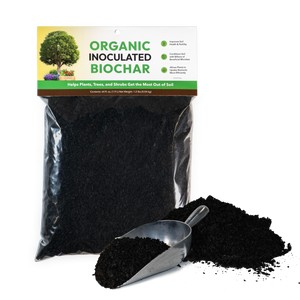
It isn't because the answer doesn't exist. To eat, a plant needs the same three things you do: macronutrients (for you this is breakfast, lunch and dinner), micronutrients (the multivitamin you might take at night), and the living microbes (probiotics) that let it use the other two. Organic versions of all three are available right now at commercial scale by companies that know what they’re doing: seaweed and kelp, worm castings, compost, fish fertilizer, volcanic ash, biochar, living microbes by the billion.
The problem is that most of it ships by the ton from one company to another, to farms and to buyers with scientists on staff. And the bags and bottles that actually reach the garden center arrive it one component at a time: a bag of nutrients, sometimes with a line about microbes on the label, and nothing telling you what it pairs with or how to mix and apply it. An ingredient isn't a solution. It's a puzzle piece handed to somebody who was never shown the picture on the box. All three things in one bag or bottle with microbes that have been proven to work: that is the product nobody ever built for the consumer.
Most people were never told they need all three, and the ones who know either can't blend them in the right proportions or won't bother. Turning organic inputs into something an ordinary person can use correctly without a master's degree is hard, and selling pallets to farms is comparatively easy. So the hard job sat there, and nobody took it.
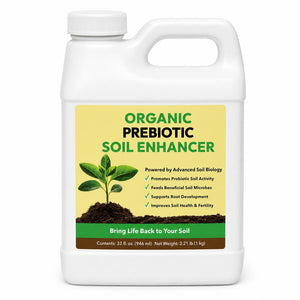
Somebody has to, and the job isn't complicated to describe. You take the good inputs, the ones already being made by people who make them well. You combine them so that they work together instead of separately, because they do work better together, and knowing which combinations do what is most of the expertise. You put the life back, the microbes we unknowingly killed off with eighty years of poisoning, so that all three things a plant needs come in one bag. And then, and this is the part that matters most, you package the result so that using it correctly is the easy path rather than the expert path. Ingredients go in, a solution comes out.
Putting the life back in your own soil is easy now, and it's easy for exactly one reason, which is that the hard part happens before the bag ever gets to you. It really is that simple. Which leaves a few things that need saying directly, to a few different audiences.
To the companies making these high-quality organic inputs: your material is good. It always was. It just never got packaged in a convenient way for the person who wanted it, and you shouldn't take that as criticism, because you built the foundation. What's missing isn't more of what you do. It's the last mile: the microbial part bundled into a simple solution that any regular person can just pick up and use.
To the industry that grows our food and cares for our lawns and landscapes: you fed the world and greened our lawns with chemistry when chemistry was all any of us could see, and nobody should take that away from you. But we now know what the microbes do, and the default you inherited has become a choice, made with information your predecessors never had.
And to anybody who's ever been told this is above their pay grade, that growing without chemicals is a premium tier, that their job is to buy whatever the shelf happens to carry: it was never above your pay grade. Your grandparents grew food in their yards as a matter of course. During the Second World War, ordinary families grew about forty percent of this country's fresh vegetables in their own backyards, with no chemical fertilizer, no app, and nobody's permission. Growing things is the oldest skill human beings have. You were just quietly talked out of it.
If there is one takeaway here, it’s this: you don't have to wait. Not for the industrial farms, not for the agrochemical companies, and not even for the grower at your Saturday market, who may well still be using synthetic fertilizer because the same default reached them too and nobody ever handed them a better one. None of them have to move first. Inertia is a powerful force, but it has one weakness, which is that it only holds as long as nothing moves, and the ground you control is ground you can take back today: your yard, your raised bed, the pot on your windowsill. That sounds like a small thing - but it isn't, because there are something like a hundred million of them in this country, and defaults change when enough people quietly stop accepting them.
Here’s the good news: the damage we did to the life in the soil over the past eighty years is reversible. Dead soil isn't permanently dead - it’s just dormant. Bring the life back to it and it wakes up in as little as one season - and this is starting to happen one backyard at a time, where somebody finally decides to stop killing the tiny organisms that make the whole system work and to start putting them back instead.
That's what this comes down to. Stop killing the life in your soil, which we all did for eighty years without knowing, and bring the life back to it, which you can start doing this weekend. Eighty years of damage doesn't get reversed by waiting for somebody else to come along and bring it back to life for you. It gets reversed one back yard at a time by people who were told this was above their pay grade and went ahead and did it anyway.
Your grandparents didn't ask permission. Neither should you.
It's time to grow.